

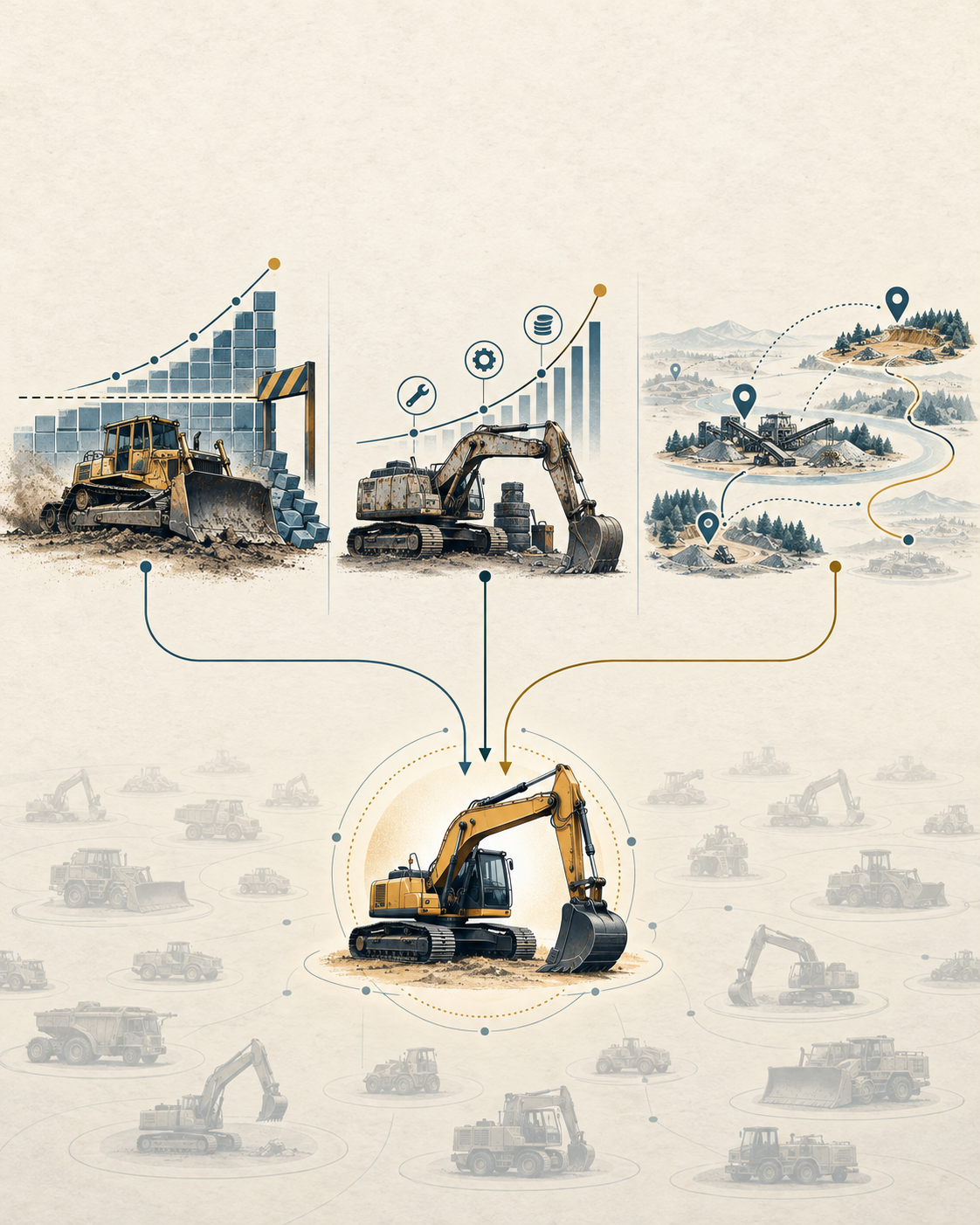
Businesses do not purchase equipment on impulse. Every purchase has an underlying operational or economic cause.
A company may face a mismatch between the capacity it has and the capacity its workload requires. Aging equipment may reach the point where continued maintenance is less economical than replacement. Expansion into new locations, routes, services, or capabilities may require equipment the business does not currently have.
These are only three examples. There are other causes, and each represents a different analytical problem.
The applied mathematics for studying capacity, replacement economics, and expansion has existed for decades. The principal limitation was practical: the necessary evidence was scattered across many sources and was too difficult and expensive to assemble, connect, and analyze at scale.
That constraint is changing.
Signum has begun implementing models for several of these causes and continues to improve both the models and the evidence supporting them.
The objective is not to apply another set of filters to a database. It is to identify the conditions from which equipment demand develops.